

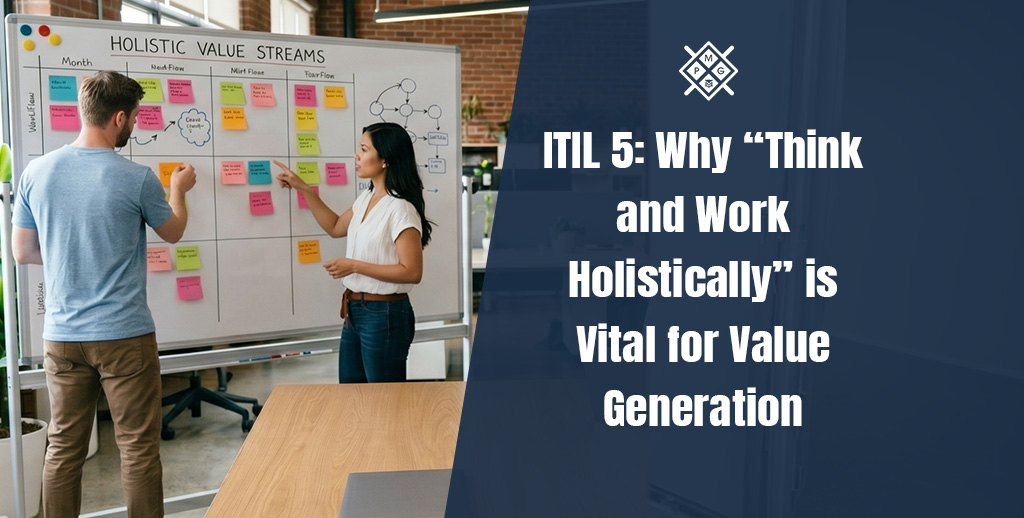
In digital service and product management, the biggest mistake an organization can make is believing its departments can function as isolated islands. With the launch of ITIL 5, the guiding principle Think and work holistically becomes even more critical to ensuring that technological complexity does not turn into operational inefficiency.
No product, practice, or team stands alone. If the output of one activity is not integrated into the whole, the results delivered to customers and stakeholders will suffer. In this article, we explore how this systemic view is applied within the Value System and how it can boost your career.
Read also: The Definitive Guide to ITIL 5
Browse topics of interest:
ToggleWhat Does Thinking and Working Holistically Mean in ITIL 5?
Working holistically means establishing a deep understanding of how all parts of an organization collaborate in an integrated manner. In ITIL 5, this requires end-to-end visibility: from the moment a demand is captured to the translation of that need into real results.
In complex systems, such as modern enterprises, a change in a single element—whether a line of code or an HR policy—can generate impacts across the entire network. Therefore, a holistic approach in the Value System includes:
- Considering the Four Dimensions of management (Organizations and People; Information and Technology; Partners and Suppliers; Value Streams and Processes).
- Observing the complete product and service lifecycle, even stages that are not under your direct control.
- Understanding the organization’s position within the global supply chain.
- Constantly monitoring external factors (PESTLE) that affect the business.
System Complexity and Decision Making
A central point of the official ITIL 5 Foundation material is the recognition that different levels of complexity require different heuristics for decision-making.
Often, managers attempt to apply rigid rules designed for simple systems to complex environments. The result? Catastrophic failures or bureaucratic processes that stifle innovation.
To work holistically, a professional must be able to identify patterns in the interactions between system elements. When designing processes within the Value Chain, it is necessary to anticipate how changes will influence final outcomes and the consumer experience.
The Role of Artificial Intelligence in the Holistic View
One of the great innovations of ITIL 5 is the native integration of Artificial Intelligence to support holistic thinking. In organizations with massive volumes of data, it is humanly impossible to see all dependencies and risks in real-time.
AI and automation facilitate this vision by:
- Providing insights into complex interactions between multiple data points.
- Identifying invisible risks and bottlenecks through advanced algorithms.
- Supporting coordinated decision-making across the entire Value System.
With the support of technology, “holistic work” ceases to be an abstract concept and becomes a data-driven practice, allowing teams to act in a synchronized manner.
How to Apply This Principle in Practice?
For you and your company to start thinking holistically today, ITIL suggests some pragmatic guidelines:
- Promote Collaboration: Establish mechanisms for stakeholders to collaborate in real-time. This prevents problems from being “pushed” to the next phase of the Value Chain.
- Look for Patterns: Do not look only at isolated incidents. Analyze history to understand which relationships between system elements are influencing results.
- Use Automation for Visibility: Implement tools that offer end-to-end dashboards, ensuring that everyone sees the impact of their actions on the final value.
Conclusion: The Differentiator of the Strategic Professional
Mastering the principle of Think and work holistically transforms an IT professional from a technical executor into a strategic business partner. It is this vision that allows for leading digital transformations with confidence, ensuring that technology truly serves the organization’s purpose.
Ready to become an ITIL 5 expert and master the Value System?
At PMG Academy, we offer comprehensive and practical training to help you earn your official certification and elevate your market authority. Explore our courses and prepare for the challenges of Industry 5.0!
Did you enjoy this content? Comment below on how your company handles integration between different teams or share your experience with the holistic view!
Categorias
Artigos Relacionados
IT Asset Management nowadays
Traditionally, IT Asset Management has never received the focus it deserves. This changed with the
Risk management: how NOT to do it
If you work with information technology, you know how important risk management is. After all,