

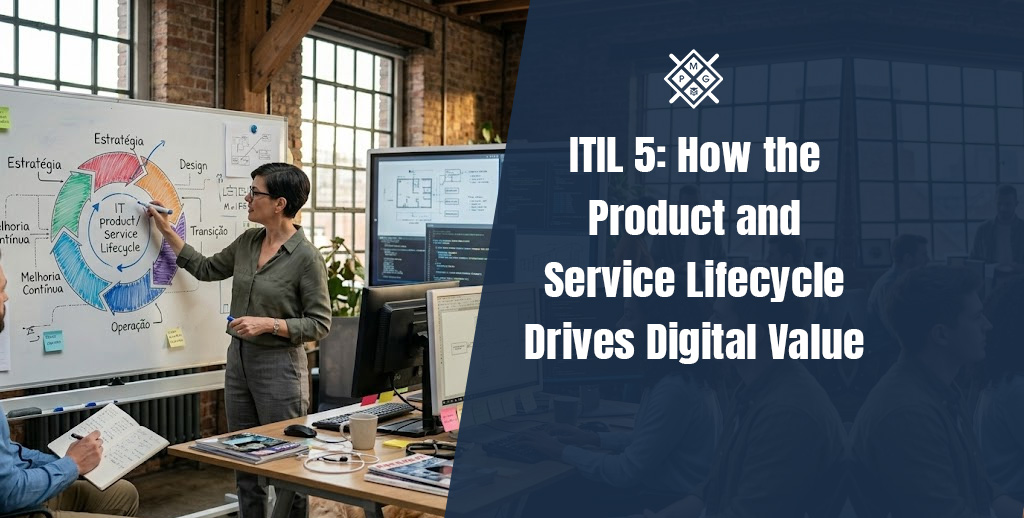
In today’s technology landscape, the line between a “product” and a “service” has become almost invisible. A banking app is a digital product, but the wire transfer you complete through it is a service. To manage this duality efficiently, ITIL 5 introduced an evolved approach: the Product and Service Lifecycle (PSLM).
Unlike the rigid, “one-size-fits-all” models of the past, the ITIL 5 lifecycle is flexible and centered on value co-creation. Understanding these stages is essential for professionals who want to align IT with business goals and ensure a seamless customer experience.
In this article, we will explore the eight fundamental stages of this lifecycle and how they connect to the Service Value Chain to transform ideas into real-world results.
Read also: The Definitive Guide to ITIL 5
Browse topics of interest:
ToggleThe New Lifecycle Structure in ITIL 5
The major innovation in ITIL 5 is the recognition that user experience depends as much on the quality of the digital product as it does on the provider’s management system. These two factors are interconnected and evolve together.
The lifecycle model should not be viewed as a straight line, but as an ecosystem where management focus shifts between the product (the technology itself) and the service (the utility delivered to the user). This holistic view allows organizations to be more agile and responsive to market shifts.
The 8 Stages of the Product and Service Lifecycle
To ensure high quality, ITIL 5 defines eight management activities that comprise the lifecycle. Each serves as a strategic milestone:
- Discover: The exploration phase. Here, the team identifies and prioritizes needs and opportunities, aligning the product roadmap with the organization’s strategy.
- Design: Focuses on creating the solution. The goal is to design products and services that not only meet technical requirements but also delight the user.
- Acquire: Involves obtaining resources. This could be purchasing third-party software or allocating the cloud infrastructure necessary for the project.
- Build: This is where the rubber meets the road. Solutions are developed, configured, and exhaustively tested before going live.
- Transition: The deployment phase. It ensures that the new product is introduced into the production environment safely and without disruption.
- Operate: Focuses on stability. This is the day-to-day management to ensure the digital product performs as agreed with stakeholders.
- Deliver: The execution of the service based on the product. This is the moment the user actually consumes what was built.
- Support: The safety net. It focuses on restoring normal operations and resolving issues when things don’t go as planned.
The Service Value Chain: “Stepping Stones” for Value Delivery
A common mistake is believing these eight stages must always follow a mandatory sequential order. In ITIL 5, these activities form the Service Value Chain.
Think of the Value Chain as a set of “stepping stones.” Depending on your company’s context or the type of product, you might jump from one stone to another in different orders.
For example, in an Agile development environment, the Design, Build, and Acquire phases might occur almost simultaneously in short feedback loops. This flexibility is what allows organizations to create customized Value Streams for every specific situation.
How This Boosts Your Career and Your Company
Mastering the ITIL 5 Product and Service Lifecycle transforms how you perceive technology. For the company, the benefits are clear: reduced waste, increased agility, and products that are better aligned with what the customer truly values.
For the professional, this understanding offers:
- Strategic Vision: You move from being a task executor to understanding the impact of every action on the company’s Value System.
- Adaptability: The ability to work with different frameworks (such as Scrum or Kanban) seamlessly integrated into ITIL.
- Technical Authority: The knowledge required to lead complex digital transformations.
Conclusion: The Path to ITIL 5 Mastery
The ITIL 5 lifecycle is the foundation for any organization looking to thrive in the digital economy. It provides the necessary structure to manage complexity without losing focus on what matters most: value creation.
Ready to become a certified specialist and master the Value Chain?
PMG Academy offers comprehensive, practical ITIL 5 training, preparing you for real-world market challenges and official certifications. Take your career to the next level with the leaders in corporate education.
Are you already applying Value Stream concepts to your routine? Share in the comments how your company organizes its digital product lifecycle!
Categorias
Artigos Relacionados
IT Asset Management nowadays
Traditionally, IT Asset Management has never received the focus it deserves. This changed with the
Risk management: how NOT to do it
If you work with information technology, you know how important risk management is. After all,
2 Responses
Please translate Navegue por tópicos de interesse to English.
Thanks for letting us know! We’ve already translated it into English. It now reads: Browse topics of interest: