Pre-order ITIL Foundation (Version 5) with a discount!

Ends:

Days
Hours
Minutes
Seconds
Detectando sua região…

+71k students

CobiT 5 Foundation
Preparatory Course for the Official PeopleCert Exam

Build your package:

✅ Best Choice:
With this package, you get the Course for just 1.00 USD.

628,00 USD

399.00 USD

* Discounted price valid for individuals only. For corporate billing, please check our pricing policy

Money-saving Tip: Add the Exam and get this Course for just 1.00 USD!

129.00 USD

99.00 USD

* Discounted price valid for individuals only. For corporate billing, please check our pricing policy

💡 Money-saving Tip: Add the Course and pay only 1.00 USD for it!

499.00 USD

398.00 USD

* Discounted price valid for individuals only. For corporate billing, please check our pricing policy

Build your package:

✅ Best Choice:
With this package, you get the Course for just 1.00 €.

628,00 €

399,00 € incl. VAT

* Discounted price valid for individuals only. For corporate billing, please check our pricing policy

💡 Money-saving Tip: Add the Exam and get this Course for just 1.00 €.

129,00 €

99,00 € incl. VAT

* Discounted price valid for individuals only. For corporate billing, please check our pricing policy

💡 Money-saving Tip: Add the Course and pay only 1,00 € for it!

499,00 €

398,00 € incl. VAT

* Discounted price valid for individuals only. For corporate billing, please check our pricing policy

About the course

The CobiT® 5 Foundation training is an official ISACA preparatory course. COBIT is a globally accepted best practice framework created by ISACA for IT governance. The course provides an end-to-end view of enterprise IT governance, reflecting the central role of information and technology in creating value for enterprises.

The practices found in CobiT® 5 incorporate thought leadership and guidance from IT, business, and governance experts worldwide.

Holding a CobiT® 5 certification indirectly improves a company’s operations, as IT management and governance help guide work in an organized manner, reducing errors.

Who Should Attend

  • Business Managers
  • IT and Business Executives
  • IT/IS Auditors
  • Internal Auditors
  • Information Security and IT Professionals
  • IT Consultants
  • IT/IS Managers

Certification & Exam

This course is preparatory for the official ISACA/PeopleCert CobiT 5 Foundation certification exam.

  • Exam language: Portuguese and English
  • Number of questions: 50 questions
  • Exam duration: 40 minutes
  • Passing score: 50% (25/50)
  • Difficulty level: Easy
  • Prerequisites: PeopleCert strongly recommends the CobiT 5 Foundation preparatory course
  • Open book exam: No
  • Exam format: Online

About Instructor

15 years of excellence in training with over 71,000 successful students.

Adriano is an ITIL Master, consultant, and author of 6 books, bringing 25 years of experience and more than 50 certifications in IT Management, Security, and Governance. As the leader of
the largest ITSM and DPSM community (+220k subscribers on YouTube), he combines his MBA from FGV—one of the world’s top-tier business schools—with a specialization in Neuroscience
to mentor a global network of over 71,000 students. His mission is clear: to demystify complex management and transform technical knowledge into tangible value and market impact.

Adriano Martins Antonio, ITIL 4 Master

Official translator of the ITIL Foundation (Version 5) Guide

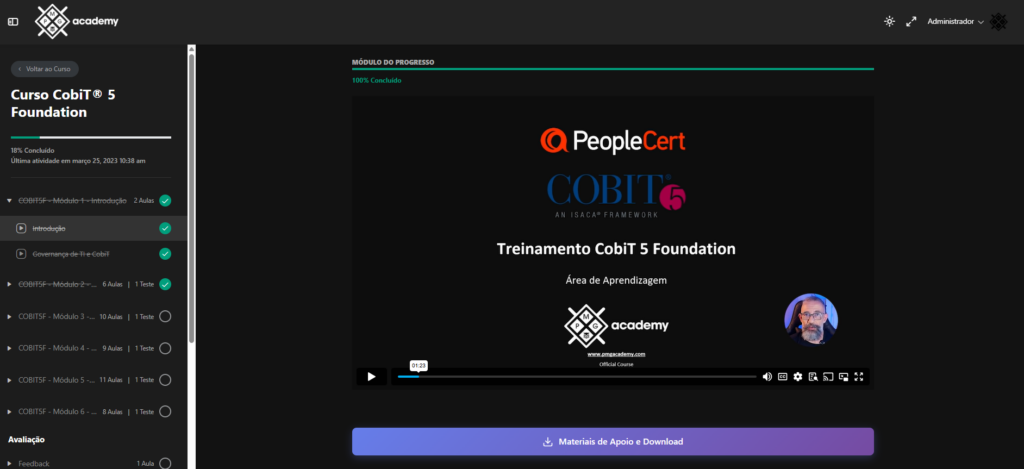
Contents

  • Welcome
  • About APMG
  • Making the Most of the Course
  • Topics
  • Purpose of the CobiT 5 Foundation Course Syllabus
  • Target Audience
  • Learning Objectives
  • Course Structure
  • Summary of Learning Areas
  • Exam Requirements
  • Exam Preparation
  • Trademarks and Patents
  • The Origin of Governance
  • Who Needs Governance
  • How Governance Helps
  • Corporate Governance in Brazil
  • How to Use COBIT in Governance
  • About COBIT
  • COBIT Controls
  • Overview – Topics
  • Learning Objectives
  • About COBIT 5
  • The Evolution of COBIT
  • Drivers for Developing a Framework – Part I
  • Drivers for Developing a Framework – Part II
  • Why Develop COBIT 5
  • COBIT 5 Scope
  • Who Needs COBIT 5
  • Information Benefits
  • Information Benefits for the Enterprise
  • Stakeholder Value
  • COBIT Benefits
  • Business Needs
  • Module 2 Exercises – CobiT 5 Foundation
  • Learning Objectives
  • COBIT 5 Principles
  • Principle 1 – Meeting Stakeholder Needs
  • Meeting Stakeholders
  • Value Creation
  • Goals Cascade
  • Goals Cascade in Practice
  • External Stakeholder Needs
  • Internal Stakeholder Needs
  • Goals Cascade Step 1
  • Goals Cascade Step 2
  • Balanced Scorecard (BSC)
  • BSC Model
  • Goals Cascade Step 3
  • IT BSC Model
  • Goals Cascade Step 4
  • Principle 2 – Covering the Enterprise End-to-End
  • Objectives of Covering the Enterprise End-to-End
  • Governance Approach
  • Governance Approach Elements
  • Governance Roles, Activities, and Relationships
  • Principle 3 – Applying a Single Integrated Framework
  • Integrator Framework
  • COBIT 5 and ISACA Legacy Frameworks
  • COBIT 5 Family
  • Principle 4 – Enabling a Holistic Approach
  • Enterprise Enablers
  • Dimensions
  • Enabler Dimensions
  • Enabler Performance Management Dimension
  • Principle 5 – Separating Governance from Management
  • Difference Between Governance and Management
  • Enterprise IT Governance Processes
  • Governance and Management Interaction
  • Appendix
  • Module 3 Exercises – CobiT 5 Foundation
  • Learning Objectives – Part I
  • Enterprise Enablers
  • Learning Objectives – Part II
  • Reviewing – Enabling a Holistic Approach
  • Enabler 1 – Principles, Policies & Frameworks
  • Difference Between Principles and Policies
  • Characteristics and Policies
  • Purposes and Connections
  • Good Practice Requirements
  • Principles, Policies & Frameworks
  • Enabler 2 – Processes
  • Definitions
  • Process Reference Model
  • Process Model Structure
  • Process Example
  • EDM01 RACI Chart
  • Practices, Inputs, and Outputs
  • Activities
  • Stakeholders
  • Process Goal Characteristics
  • Relationship Between Processes and Enablers
  • Enabler 3 – Organizational Structures
  • Roles and Organizational Structure – Part I
  • Enabler 4 – Culture, Ethics, and Behavior
  • Ethics and Principles
  • Relationship with Goals
  • Relationship with Other Enablers
  • Enabler 5 – Information
  • COBIT 4.1 Cube – Information Criteria – Business Requirements
  • COBIT 4.1 Business Requirements
  • Requirement Equivalence in COBIT 5
  • COBIT 5 Information Model
  • Information Lifecycle
  • Good Practices – Information Attributes
  • Information Model – New Application
  • Information Model – Data Protection
  • Contextual and Representational Quality
  • Enabler 6 – Services, Infrastructure, and Applications
  • Service Capabilities
  • Relationship with Other Enablers
  • Enabler 7 – People, Skills, and Competencies
  • Skill Categories
  • Process Division
  • Module 4 Exercises – CobiT 5 Foundation
  • Learning Objectives
  • Implementation Guide
  • COBIT 5 – Implementation
  • Challenges to Success
  • The Seven Phases of the Implementation Lifecycle
  • Internal and External Enterprise Factors
  • Key Success Factors
  • Implementation – Phase 1
  • Phase 1 – What are the drivers?
  • Creating the Appropriate Environment
  • Pain Points
  • Trigger Events
  • Implementation – Phase 2
  • Phase 2 – Where are we now?
  • Implementation – Phase 3
  • Phase 3 – Where do we want to be?
  • Implementation – Phase 4
  • Phase 4 – What needs to be done?
  • Implementation – Phase 5
  • Phase 5 – How do we get there?
  • Implementation – Phase 6
  • Phase 6 – Did we get there?
  • Implementation – Phase 7
  • Phase 7 – How do we keep the momentum going?
  • Component Relationships
  • Characteristics of a Good Case Study
  • Content of a Case Study
  • Module 5 Exercises – CobiT 5 Foundation
  • Learning Objectives
  • What is a Process Assessment
  • Process Capability Assessment
  • What is a COBIT Assessment Program
  • Process Capability Assessment
  • Differences Between Capability and Maturity Assessment
  • Differences from a CMM Model
  • Benefits of the New Approach
  • COBIT 4.1 CMM vs ISO 15504 Attributes
  • Key ISO 15504 Definitions
  • Advantages of an ISO 15504 Approach
  • The Process Assessment Model (PAM)
  • Differences Between Capability and Process Dimensions
  • Indicators with COBIT 5 PRM
  • Indicators
  • Process Capability Example
  • Process Capability Levels
  • Measurement Model
  • Process Attribute Rating Scale
  • Attributes and Capability Level
  • Example – Target Process Capability
  • Consequences of Capability Gaps
  • Consequences of Probabilities
  • Summary of Assessor Assessment Steps
  • Assessment Process Activities
  • 2. Planning the Assessment – 3. Briefing
  • 4. Data Collection
  • 5. Data Validation – 6. Process Attribute Rating
  • 7. Reporting the Results
  • Module 6 Exercises – CobiT 5 Foundation
  • Mock Exam 1 – CobiT 5 Foundation: 50 Questions
  • Mock Exam 2 – CobiT 5 Foundation: 50 Questions
  • Mock Exam 3 – CobiT 5 Foundation: 50 Questions
  • Mock Exam 4 – CobiT 5 Foundation: 50 Questions
  • Mock Exam 5 – CobiT 5 Foundation: 50 Questions
  • Mock Exam 6 – CobiT 5 Foundation: 50 Questions
  • Mock Exam 7 – CobiT 5 Foundation: 50 Questions
  • Mock Exam 8 – CobiT 5 Foundation: 50 Questions
  • Mock Exam 9 – CobiT 5 Foundation: 50 Questions
  • Mock Exam 10 – CobiT 5 Foundation: 50 Questions

Support & Contact

WhatsApp

Chat with us

Email

Send a message

FAQ

Common questions

For over 15 years, PMG Academy has maintained one of the fastest response SLAs in the market. Whether you are a prospective or enrolled student, our average response time is just 15 minutes!

* Business Hours: Monday to Friday, 13:00 to 22:00 (London Time / GMT+0)

Reviews

Ronaldo Azevedo
Codevasf
August 26, 2025

Excellent training.

Suelen
RTM Rede de Telecomunicações para o Mercado
August 6, 2025

Objective course, straight to the point. The best training school! Outstanding.

Fabiana
Connectcom
August 1, 2025

Very well explained.

1 2 ... 5 Next Page

Who Trusts PMG Academy