

Table of Contents
- Introduction to ITIL® Version 5 and Digital Product & Service Management
- Key Concepts in Product and Service Management
- Service Relationships
- The ITIL® Version 5 Value System
- Governance
- ITIL® Version 5 Guiding Principles
- The Value Chain and the Product Lifecycle
- Value Stream Mapping and Management
- Continual Improvement
- The Four Dimensions of Service Management
- Integrating ITIL® Version 5 with Other Frameworks
- Glossary of Terms
1. Introduction to ITIL® Version 5 and Digital Product & Service Management
ITIL® Version 5 emerged to bridge the gap between digital product development and effective service management. Unlike approaches that focus exclusively on technology, this framework reflects the transition to Industry 5.0, prioritizing collaboration between humans and technology, resilience, and sustainability.
By adopting an integrated approach through the Four Dimensions of Service Management — Organizations and People, Information and Technology, Partners and Suppliers, and Value Streams and Processes — ITIL 5 eliminates operational silos. Its central objective is to orchestrate all components of the organization to ensure the continuous co-creation of value with customers and other stakeholders.
What is the latest version of ITIL?
Currently, the most up-to-date version of the ITIL framework is Version 5. However, it is important to understand how ITIL has evolved.
1.1 What is ITIL Version 5 and how it differs from ITIL 4
ITIL Version 5 is the natural evolution for an AI-Native environment. While ITIL 4 focused on services, Version 5 focuses on the full integration of digital products and services. It provides practical guidance on how to manage complexity and use intelligent automation to make informed decisions.
Learn all the differences between ITIL V3, ITIL 4, and the new ITIL Version 5 by clicking here.
1.1.1 Is ITIL Version 5 a continuation or a new framework?
It is a continuation. It incorporates proven concepts from ITIL 4, such as the Service Value System and guiding principles, but expands the perspective to include the digital product lifecycle. Candidates who already hold the ITIL 4 Foundation certification do not need to retake it; it is recognized as a prerequisite for Version 5 advanced modules.
1.2 Key benefits of ITIL Version 5 for digital and agile environments
-
Practicality: More relevant for professionals working with modern digital products.
-
AI-Ready: Helps professionals operate effectively in AI-enabled environments.
-
Focus on Digital Experience: Places user and customer experience at the center of design and delivery.
1.3 Direct comparison: ITIL V3 vs ITIL 4 vs ITIL Version 5
| Characteristic | ITIL V3 | ITIL 4 | ITIL Version 5 |
|---|---|---|---|
| Main Focus | Processes and Lifecycle | Value and Practices | Digital Products and AI |
| Approach | Linear and Rigid | Holistic and Flexible | Adaptive and Complex |
| Customer Relationship | Service Delivery | Co-creation of Value | Total Digital Experience |
| Technology | Infrastructure Support | Business Enabler | AI-Native and Automation |
In V3, the focus was on Change Control, often bureaucratic. In ITIL 4, this evolved into Change Enablement, focusing on removing barriers so changes could occur safely and quickly. In Version 5, this becomes even more automated, integrating directly with CI/CD (Continuous Integration and Continuous Delivery) pipelines.
1.4 Which ITIL version makes the most sense for each type of organization
-
Traditional companies: May still use ITIL V3 concepts to organize legacy infrastructure but should migrate to ITIL 4 for agility.
-
Startups and digital companies: ITIL 4 and ITIL Version 5 are essential due to market speed and uncertainty.
-
Innovation-focused organizations: ITIL Version 5 is ideal for those already using AI and requiring governance for complex digital products.
1.4.1 What are the types of changes in ITIL?
Regardless of the version, ITIL generally classifies changes into three types:
-
Standard: Low risk, pre-authorized, and frequent.
-
Normal: Requires scheduling, assessment, and authorization.
-
Emergency: Implemented as quickly as possible to resolve a major incident.
1.4.2 What is a standard change in ITIL 4?
It is a change that follows an established procedure, with well-known and accepted risks. A practical example is updating approved software on a workstation.
1.5 What is ITIL v5? The evolution toward Industry 5.0
ITIL v5 is the most widely adopted best-practice framework for managing technology-enabled services worldwide. It is the common language that allows Development, Operations, and Business to collaborate effectively in value co-creation.
Version 5 reflects the shift from Industry 4.0 (focused on automation) to Industry 5.0, which values collaboration between humans and technology, sustainability, and resilience. This evolution is expressed through a fundamental change in focus:
-
From Traditional ITSM to Digital Product and Service Management: ITIL is no longer a support manual but the operating system of modern organizations.
-
From Systems to Products and Services: The focus is no longer on managing “IT systems,” but on the full lifecycle of digital products and services that solve business problems.
-
From Outputs to Outcomes and Experience: Success is no longer measured by delivering outputs (like reports), but by enabling business outcomes (such as reducing hiring time) and ensuring a positive customer experience.
1.5.1 The integrated and holistic approach
The strength of ITIL v5 lies in three key characteristics:
-
Holistic: Forces a whole-system view through the Four Dimensions of Service Management. Excellence in one area cannot compensate for deficiencies in another.
-
Practical: Moves beyond theory into applicable principles, practices, and models.
-
Coherent: Connects executive strategy to operational execution so everyone moves in the same direction.
One of the biggest advances of ITIL Version 5 is its native integration with Lean, Agile, and DevOps. Stop the “ITIL vs Agile” debate. That is amateur thinking. ITIL 5 is not a competitor but the governance structure that provides the stability and control required for DevOps agility to scale without turning into chaos.
1.5.2 The official ITIL® Version 5 qualification scheme
Where can your career go from here? Let’s look at the map. The ITIL v5 certification journey is structured to build knowledge from foundational to strategic mastery.
-
ITIL® Version 5 Foundation: The foundation. Validates that you speak the ITIL language and understand the Service Value System. Mandatory prerequisite for all other levels.
-
ITIL® Version 5 Practice Manager (PM): A specialization path focused on day-to-day operations.
-
ITIL® Version 5 Managing Professional (MP): For professionals managing digital products, teams, and value streams.
-
ITIL® Version 5 Strategic Leader (SL): For leaders defining digital direction and business strategy.
-
ITIL® Version 5 Master: The pinnacle qualification for professionals who can apply ITIL principles to achieve strategic business outcomes.
Understanding this structure is the first step. Now, it is time to dive into the fundamental concepts that underpin the entire framework.
2. Key Concepts in Product and Service Management
In modern management, it’s essential not to confuse shipping software with delivering a service. In ITIL 5, a product is a configuration of an organization’s resources (people, technology, and more) designed to offer value. A service, in turn, is the means of enabling the co-creation of value by facilitating the outcomes customers want to achieve—without requiring them to manage specific costs and risks.
If you focus only on the product (the technical output) and fail at the service (the ability to enable the business outcome), you destroy perceived value. Success depends on ensuring that a digital product doesn’t just work—it must reliably enable the outcomes stakeholders actually care about.
2.1. Core Definitions: Product vs. Service
In ITIL® Version 5, these words have precise, distinct meanings. Pay close attention here.
| Concept | ITIL® Version 5 Definition |
| Product | A configuration of an organization’s resources (people, technology, etc.) designed to offer value to a consumer. |
| Service | A means of enabling the co-creation of value by facilitating the outcomes customers want to achieve, without the customer having to manage specific costs and risks. |
The modern economy increasingly prioritizes access over ownership. Consumers want capability (e.g., “send email”) and transfer the responsibility for infrastructure costs and risks—maintenance, hardware, and uptime—to the provider.
2.2. The Digital World: Digital Product and Digital Service
Applied to the digital context, the definitions become:
- Digital product: A combination of an organization’s resources, based on digital technology, designed to offer value to consumers.
- Digital service: A service that depends entirely—or largely—on digital products.
The relationship is symbiotic: a high-quality digital service depends on a robust digital product. The digital product provides the capabilities (the engine), while the digital service delivers the value (the trip).
For example: a bank’s mobile app, along with its APIs and core systems, is the digital product. Being able to pay a bill securely and instantly at 11 p.m. on a Sunday is the digital service. If the product fails (the app crashes), the service is disrupted—and value evaporates.
2.3. The ITIL® Version 5 Product and Service Lifecycle
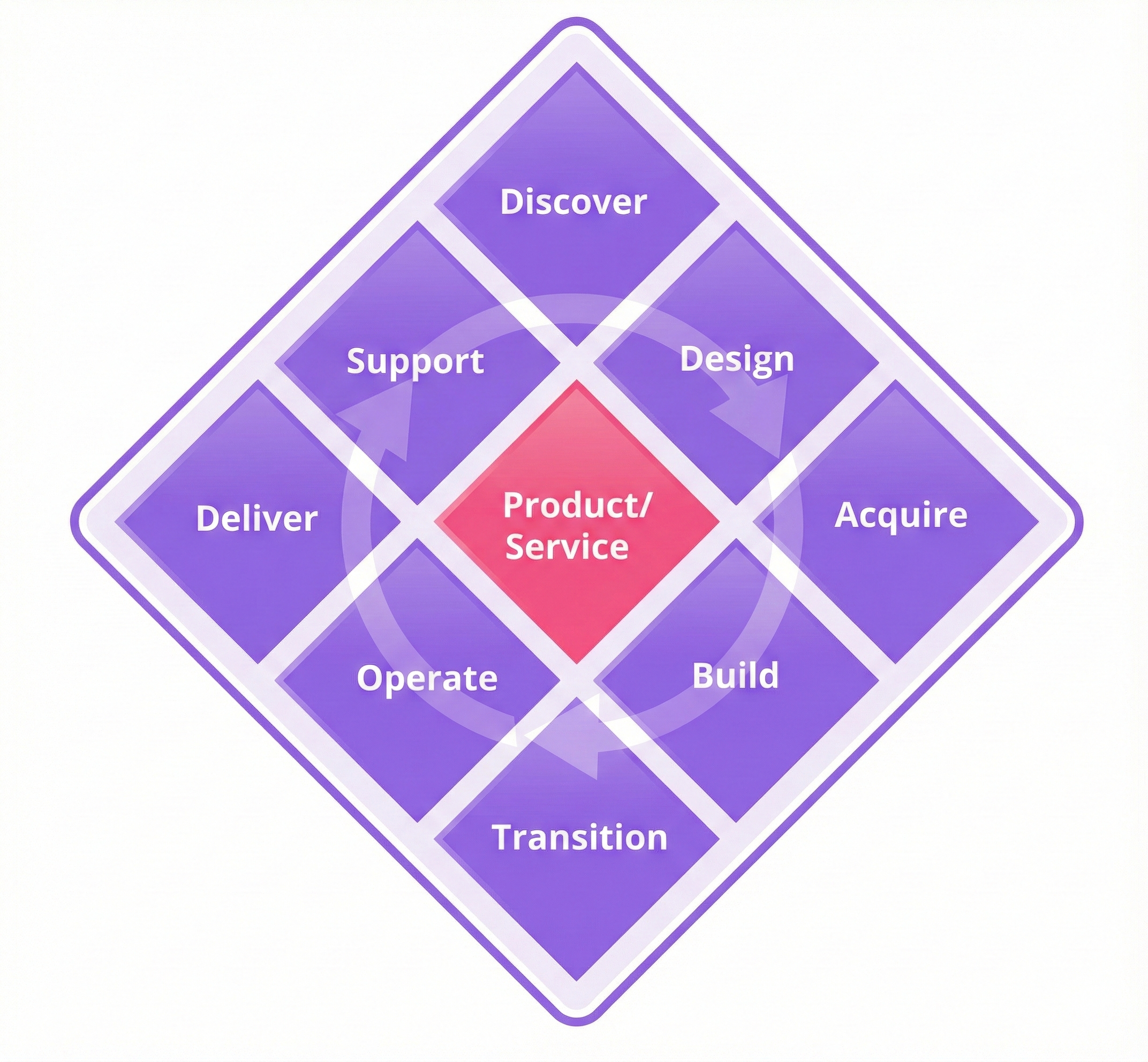
To manage that relationship, ITIL® Version 5 proposes a Lifecycle Model that integrates product and service management activities. This is not a rigid, linear sequence—it’s a set of activities that can be combined into value streams.
The eight management activities are:
- Discover: Understand what the market needs and align it with the organization’s strategy.
- Design: Plan the solution by creating prototypes and detailed specifications.
- Acquire: Obtain the required resources—by buying, hiring, or building.
- Build: Code, configure, assemble, and test the components of the digital product.
- Transition: Move the product safely from development into production.
- Operate: Keep infrastructure and systems running and monitor performance.
- Deliver: Make the service available for user consumption, managing access and requests.
- Support: Resolve incidents and problems, restoring normal service operation.
This model has an important duality: the early stages (Discover, Design, Acquire, Build) lean more toward Product, while the later stages (Deliver, Support) lean more toward Service. The middle stages (Transition, Operate) act as the bridge between the two worlds.
2.4. The Value Equation: Outcomes, Costs, and Risks
Value isn’t something a provider simply “delivers” as a finished package. It emerges from the interaction between provider and consumer.
2.4.1. Output vs. Outcome
This is the single most critical distinction in modern management. If you don’t understand it, you won’t pass the exam.
- Output: A tangible or intangible deliverable produced by an activity.
Example: a new HR system installed and running. - Outcome: A result for a stakeholder enabled by one or more outputs.
Example: reducing time-to-hire from 30 days to 10 days, enabled by the new HR system.
It’s entirely possible to deliver the output (the system is live) without achieving the outcome (no one uses it because it’s too complex). ITIL® Version 5 requires a relentless focus on outcomes—because that’s what customers actually “buy”: efficiency, profit, speed, and confidence—not just software.
2.4.2. Value, Cost, and Risk
These three elements form the equation behind a customer’s perception of value.
- Value: The perceived benefits, usefulness, and importance of something.
- Cost: The amount of money spent on an activity, resource, product, or service.
- Risk: A possible event that can cause harm or loss—or make it harder to achieve objectives.
A service only has value when its positive effects outweigh its negative ones. The equation is:
Value = (Outcomes Achieved + Costs Removed + Risks Removed) − (Costs Imposed + Risks Imposed)
From the consumer’s perspective, costs and risks can be removed (e.g., not having to buy a server) or imposed (e.g., paying a monthly subscription). For a service to be valuable, the benefits and removals must significantly outweigh the costs and risks the service introduces.
2.5. Service Offerings
A service offering is how a service is presented to the consumer. Think of it as a restaurant menu: it describes what’s available, what it includes, and how it’s priced. A service offering may include goods, access to resources, and service actions.
A service offering is made up of a combination of three elements:
- Transfer of goods: Ownership of a resource (physical or digital) is transferred to the consumer.
Example: a new phone provided as part of a mobile plan. - Service actions: Activities performed by the provider for the consumer.
Example: technical support resetting a password. - Access to resources: The consumer gains the right to use resources owned by the provider.
Example: access to a 4G network or a cloud computing platform.
In modern digital services—especially SaaS and cloud—the dominant component is typically access to resources, reflecting the broader shift toward consuming capabilities instead of acquiring assets.
With the concepts of value and service established, the next step is to understand how provider–consumer relationships are managed so value co-creation can actually happen.
3. Service Relationships
Let go of the idea that a service relationship is one-way—“I pay, you deliver, and if something goes wrong, it’s your fault.” That logic works when you’re buying pens. It does not work for IT services. Value co-creation depends on active cooperation.
3.1. Roles and Responsibilities in the Service Ecosystem
For collaboration to work, roles and responsibilities must be clear.
- Organization: A person or group of people with their own functions, authorities, and relationships to achieve objectives.
- Service provider: The organization responsible for delivering and supporting services. Its focus is ensuring the service operates effectively.
- Service consumer: The organization responsible for acquiring and using services to achieve its own objectives.
- Digital product vendor: The organization responsible for creating and improving the digital products (e.g., software) that underpin services. Often, the vendor and provider are the same company (e.g., Salesforce). In other cases, a provider may implement and support a vendor’s product (e.g., SAP).
3.2. The Service Consumer Triad
Inside the consuming organization, the “customer” role splits into three distinct personas—and their priorities don’t always align.
- Sponsor: Approves the budget for the service. Their primary interest is cost-benefit and return on investment (ROI).
- Customer: Defines service requirements and takes accountability for the outcomes of consumption. They want the service to solve a business problem.
- User: Uses the service day to day. Their primary interest is ease of use and user experience (UX).
A classic conflict shows up when a company buys mobile services: the Sponsor (CFO) wants the cheapest plan. The Customer (CIO) defines technical requirements like 5GB of data and roaming. Users (employees) want a phone that’s easy to use and actually gets a signal. An effective provider has to navigate these competing interests and find a balance that delivers value to all three.
3.3. The Service Relationship Model
ITIL® Version 5 describes the service relationship through an interactive model:
- Service provision: All activities performed by the provider to make the service available.
- Service consumption: Activities performed by the consumer to use the service. This includes managing the consumer’s required resources (e.g., having a computer) and performing actions (e.g., opening a ticket).
- Service relationship management: Joint activities performed by both parties to ensure continuous value co-creation. A crucial element here is the provider educating the consumer on how to consume the service effectively.
3.4. Types of Service Relationships
Not all relationships are created equal. The nature of the service determines the level of engagement required.
| Relationship Type | Primary Focus | Characteristics |
| Basic | Efficiency and Support | Typical for off-the-shelf (commodity) services. Standardized, transactional, with little customization. |
| Cooperative | Improvement and Effectiveness | The provider acts as a “trusted advisor,” understanding the customer’s needs and configuring the service. |
| Collaborative (Partnership) | Innovation and Growth | Objectives and risks are shared. Teams blend together to co-create solutions. Highly customized. |
Trying to force a collaborative partnership with a commodity provider creates waste. Treating an innovation partner as purely transactional destroys value. Choosing the right relationship type is a strategic decision.
3.5. The Service Journey
The service relationship evolves through a lifecycle known as the Service Journey. The seven stages are:
- Explore: Both parties investigate the market, needs, and available capabilities.
- Engage: The relationship is established, building early communication and trust.
- Offer: The provider presents service offerings, and the consumer articulates demand.
- Agree: Expectations are aligned and formalized—typically through a contract or SLA.
- Onboard: The transition stage, where the consumer begins using the service and users are trained.
- Co-create: The day-to-day of service provision and consumption, where value is actually generated.
- Reflect: A continual improvement stage, where both parties evaluate performance and the value created.
3.6. Quality, Service Levels, and SLAs
Measuring the success of a service relationship requires separating quality from service level.
- Service quality: The totality of service characteristics relevant to its ability to satisfy needs. It’s the overall perception that “this is a good service.”
- Service level: A set of objective, measurable metrics that define expected service quality (e.g., “99.9% availability”).
To translate quality perception into manageable metrics, ITIL® Version 5 proposes four categories:
- Utility: What the service does—its functionality to meet a specific need (fit for purpose).
- Warranty: How the service performs—the assurance it will meet requirements for availability, capacity, continuity, and security (fit for use).
- Experience: How the user feels—the sum of functional and emotional interactions a user has with the service.
- Sustainability: The service’s impact—ensuring it meets environmental, social, and economic requirements.
These metrics are formalized in a Service Level Agreement (SLA), a document that establishes service targets and aligns expectations between provider and customer.
All of these concepts need to sit inside a cohesive structure. ITIL® Version 5 proposes the Service Value System as the model that integrates everything.
4. The ITIL® Version 5 Service Value System
The Value System (VS) is the model that integrates all organizational components and activities to facilitate value co-creation. Its architecture is designed to eliminate operational silos by ensuring different departments work in a coordinated way toward a common goal.
The VS’s core purpose is to process opportunities and demand and transform them into real value for customers and other stakeholders.
4.1. Definition and Purpose of the Value System
The ITIL® Version 5 Service Value System is a model that represents how all components and activities of an organization work together to enable value creation. Its primary purpose is to ensure the organization continuously co-creates value with all stakeholders.
The model describes a logical left-to-right flow:
- Inputs: The system is triggered by Opportunity (a possibility to add value) and Demand (the need for products and services).
- Processing: At the center, a set of interconnected components processes these inputs.
- Output: The result is the creation of Value for the organization and its customers.
4.2. The Five Components of the Value System
At the heart of the Service Value System are five interrelated components:
- Guiding Principles: Universal recommendations that guide the organization in all circumstances—like a compass for decision-making.
- Governance: The system by which the organization is directed and controlled. The governing body sets strategic direction and monitors performance.
- Service Value Chain: The core operating model of the VS—an interconnected set of activities an organization performs to create and deliver products and services.
- Management Practices: Sets of organizational resources designed to perform work. ITIL® Version 5 defines 34 practices (e.g., Incident Management, Change Enablement, etc.) that function as the “tools” used to execute value chain activities.
- Continual Improvement: A recurring activity at all levels to ensure performance continually meets stakeholder expectations.
To understand how the Service Value System operates, we’ll dive deeper into each component—starting with the layer that establishes direction and control: Governance.
5. Governance
Don’t confuse governance with management. Governance is the ship’s captain: it sets the route and makes sure we’re doing the right thing. Management is the crew: it runs the sails and the helm to follow that route, making sure we’re doing things the right way. If the captain goes downstairs to scrub the deck, that’s management—and the ship hits the rocks.
5.1. The Role of the Governing Body
Governance is the system by which an organization is directed and controlled. In a digital context, digital technology governance is the system by which the use of technology is governed—including direction, monitoring, and accountability.
Every organization has a governing body—for example, a board of directors. This group holds ultimate accountability for the organization’s performance and compliance. It does not run day-to-day operations; instead, it ensures the management system is operating effectively and aligned with strategic objectives.
5.2. The EDM Governance Cycle: Evaluate, Direct, and Monitor
Governance is exercised through a continuous cycle of three core activities, known as the EDM model:
- Evaluate: The governing body evaluates the organization, its strategy, portfolio, and relationships. In this phase, changes in the internal and external context are analyzed to determine direction.
- Direct: Based on evaluation, the governing body defines and assigns responsibilities, and sets the strategic direction and policies management must follow.
- Monitor: The governing body monitors organizational performance and practices to ensure they comply with policy and remain on the intended course.
Note: For the EDM cycle to work, a critical enabling activity is engaging stakeholders. Governance must listen to shareholders, customers, and regulators to make informed decisions.
While governance defines the rules of the game, the guiding principles provide the compass for day-to-day decision-making.
6. ITIL® Version 5 Guiding Principles
If governance is the road map that shows the rules of the highway, the Guiding Principles are the compass that helps you navigate when the route isn’t clear—or when the map catches fire. They are universal, enduring recommendations that guide decision-making in all circumstances, fostering a unified, effective service management culture.
6.1. Focus on Value
Definition: All activities conducted by the organization should link, directly or indirectly, to value for the organization, its customers, and other stakeholders.
Analysis: This is the foundational principle. Every task, project, or process should answer: “How does this contribute to value creation?” Applying it means understanding who the consumer is and what they consider valuable—and ensuring everyone on the team understands how their work impacts the customer’s end result.
6.2. Start Where You Are
Definition: Don’t start from scratch without first considering what’s already available to leverage.
Analysis: The temptation to throw away “legacy” systems is strong—but often wasteful. This principle encourages an objective assessment of the current state, identifying what works and can be reused. Direct observation of the work (Lean’s gemba walk) is often more valuable than reports that can hide reality. Starting from zero should be the exception, not the rule.
6.3. Progress Iteratively with Feedback
Definition: Don’t try to do everything at once. Organize work into smaller, manageable chunks that can be executed and completed in a timely way.
Analysis: Instead of “big bang” projects that take years to deliver value, this principle advocates short improvement cycles (iterations). Each iteration should produce a tangible result, followed by feedback from customers and users. This reduces risk and keeps the final outcome aligned with real needs.
6.4. Collaborate and Promote Visibility
Definition: Work across organizational boundaries to achieve bigger outcomes and build stakeholder engagement, understanding, and trust.
Analysis: Silos are one of the greatest enemies of value delivery. Effective collaboration requires information, shared understanding, and trust. To enable that, the work should be visible to everyone involved—using tools like Kanban boards. Collaboration doesn’t mean universal consensus; it means relevant parties are heard before decisions are made.
6.5. Think and Work Holistically
Definition: No service, practice, process, department, or supplier works in isolation. Outcomes are achieved through the integrated work of all parts of the system.
Analysis: Optimizing one part of the system at the expense of the whole is counterproductive. This principle recognizes services as complex systems. A change in one of the Four Dimensions (e.g., technology) will inevitably affect the others (e.g., people and processes). Success depends on ensuring the end-to-end value flow works.
6.6. Keep It Simple and Practical
Definition: If a process, service, action, or metric doesn’t produce value or a useful outcome, eliminate it. Use the minimum number of steps needed to achieve the objective.
Analysis: This is the anti-bureaucracy principle. Unnecessary complexity creates waste. One key warning: trying to design a solution for every exception leads to overcomplication. Processes should be designed for the happy path (what happens 90% of the time), rather than being locked down by rules meant to cover rare edge cases.
6.7. Optimize and Automate
Definition: Maximize the value of work performed by human and technical resources. Human intervention should happen only where it’s genuinely needed.
Analysis: The word order matters. Here’s the rule of thumb: “Automating an efficient process amplifies efficiency. Automating an inefficient process amplifies inefficiency.” Optimize first—simplify, remove waste, standardize. Only after the process is lean and effective should you apply technology to execute it faster and more reliably.
6.8. How the Principles Work Together
The seven principles aren’t isolated—they’re interdependent and reinforce one another. Their full strength shows up when applied together. For example, to optimize and automate, you first need to start where you are (understand the current process), keep it simple and practical (remove waste), and think and work holistically (avoid breaking other parts of the system). Together, they form the philosophy that guides practical execution.
7. The Value Chain and the Product Lifecycle
If the Guiding Principles are the philosophy, now we’re getting into the engineering. At the heart of the VS is the engine that turns demand into value: the Service Value Chain. And to understand how products and services evolve over time, we use the Lifecycle Model. Don’t mix them up.
7.1. The Value Chain
The Value Chain is the core operating model of the Service Value System. It represents a set of six interconnected activities that an organization combines in flexible ways to form value streams tailored to different scenarios.
Think of these activities like LEGO bricks—you assemble them differently depending on the specific demand you’re trying to satisfy.
The six Value Chain activities are:
- Plan: Ensure a shared understanding of the vision, current status, and improvement direction for all products and services.
- Improve: Ensure continual improvement of products, services, and practices across all value chain activities and the Four Dimensions.
- Engage: Provide a clear understanding of stakeholder needs, transparency, and strong relationships.
- Design & Transition: Ensure products and services continually meet stakeholder expectations for quality, cost, and time to market.
- Obtain/Build: Ensure service components are available when and where needed, and meet agreed specifications.
- Deliver & Support: Ensure services are delivered and supported according to agreed specifications and expectations.
7.2. The ITIL® Version 5 Product and Service Lifecycle
While the Value Chain describes the operating engine, the Product and Service Lifecycle Model describes the full journey of a product or service—from the first idea to retirement. The lifecycle activities (often shown in the “diamond” model) are enabled by combinations of the six Value Chain activities and the 34 management practices.
7.2.1. Discover
- Purpose: Ensure product roadmaps and service offerings remain continuously aligned with consumer needs and organizational strategy.
- Outputs: Updated product and service roadmaps.
- Enabling practices: Business Analysis, Portfolio Management, Relationship Management.
7.2.2. Design
- Purpose: Create prototypes and specifications for products and services, detailing functionality, user experience, and the operating model.
- Outputs: Product/service specifications; prototypes.
- Enabling practices: Architecture Management, Service Level Management, Service Design.
7.2.3. Acquire
- Purpose: Secure and allocate required resources (hardware, software, people, etc.) efficiently.
- Outputs: Acquired resources and services.
- Enabling practices: Supplier Management, IT Asset Management, Service Financial Management.
7.2.4. Build
- Purpose: Develop, integrate, and test digital products—turning designs into working solutions.
- Outputs: Built and tested product solutions.
- Enabling practices: Software Development and Management, Infrastructure and Platform Management, Service Validation and Testing.
7.2.5. Transition
- Purpose: Introduce new or updated products into operational environments safely and effectively.
- Outputs: Products deployed into the target environment and ready for operation.
- Enabling practices: Change Enablement, Release Management, Deployment Management.
7.2.6. Operate
- Purpose: Maintain and monitor digital products and supporting systems to ensure optimal performance and reliability.
- Outputs: Products and services operating; performance records.
- Enabling practices: Monitoring and Event Management, Infrastructure and Platform Management.
7.2.7. Deliver
- Purpose: Provide services to users by managing access and requests, and collecting feedback.
- Outputs: Services delivered to consumers; SLA performance reports.
- Enabling practices: Service Request Management, Service Level Management, Service Desk.
7.2.8. Support
- Purpose: Identify and resolve incidents and problems, restoring normal service operation as quickly as possible.
- Outputs: Normal operation restored; workarounds; root cause analysis.
- Enabling practices: Incident Management, Problem Management, Service Desk, Service Continuity Management.
7.3. ITIL® Version 5 Management Practices
A management practice is a set of organizational resources (people, processes, technology, partners) designed to perform work. It’s broader than a “process.”
ITIL® Version 5 defines 34 management practices that function like the “ingredients” enabling value chain activities. No practice belongs to only one activity—practices are combined as needed to build real workflows.
The strategic combination of value chain activities to meet a specific customer demand is what ITIL® Version 5 calls a value stream.
8. Value Stream Mapping and Management
Think of a cake recipe. The written recipe is the process. The real-life chaos in a packed restaurant kitchen—where that cake actually has to get to the table—is the value stream.
Processes are idealized models. Value streams are how those processes get adapted to the messy reality of the real world to deliver value. Managing the real flow—not the perfect theoretical process—is essential for finding and eliminating waste, like the time work sits waiting between departments.
8.1. Types of Value Streams
There are two main types of value streams:
- Core value stream: Delivers products and services directly to an external consumer. This is what generates revenue.
Example: the full flow from a customer order to product delivery. - Enabling value stream: Delivers value to an internal customer so they can support the core stream. These are “behind-the-scenes” activities.
Example: the end-to-end flow for hiring a new employee.
8.2. Value Stream Mapping
Value Stream Mapping (VSM) is a Lean technique used to visualize, analyze, and improve workflow. The goal is to map the current state (as-is) to make the invisible (waste) visible. The process typically follows these steps:
- Identify: Select the value stream to be mapped.
- Map the as-is: Document the real sequence of steps, including processing time and wait time.
- Analyze: Identify bottlenecks and non-value-adding activities (waste).
- Map the to-be: Design an ideal future state by removing waste.
- Plan and implement: Create an action plan to transition from as-is to to-be.
8.3. Mapping vs. Management
Mapping and managing a value stream are different activities:
| Value Stream Mapping (Mapping) | Value Stream Management (Management) |
| It’s a one-time or periodic technique. | It’s an ongoing practice and a mindset. |
| It’s a “snapshot” of the current and future state of the flow. | It’s the day-to-day “movie,” ensuring work keeps flowing. |
| Focuses on diagnosing problems and designing improvements. | Focuses on continuous optimization and removing impediments. |
| The outcome is a visual map and an action plan. | The outcome is faster value delivery with higher quality. |
To ensure these value streams keep evolving, the organization needs a dedicated VS component: Continual Improvement.
9. Continual Improvement
Improvement should never be treated as a one-off event—or a project with a finish line. It’s a recurring organizational activity, performed at every level, to ensure performance continuously keeps pace with stakeholder expectations.
For results to be sustainable, improvement has to be embedded in the organization’s culture. Otherwise, teams slide back to the old baseline and lose momentum. When improvement stops, organizations drift into obsolescence and inefficiency. That’s why continual improvement must become a constant, iterative habit—one that protects resilience and long-term value.
9.1. The ITIL® Version 5 Continual Improvement Model
ITIL v5 provides a structured approach to improvement through its seven-step Continual Improvement Model. It’s iterative and works for problems of any size.
9.1.1. Step 1: What is the vision?
- Purpose: Ensure the improvement initiative aligns with the organization’s vision and strategic objectives.
- Key question: How does this improvement support business goals?
9.1.2. Step 2: Where are we now?
- Purpose: Perform an objective assessment of the current state, collecting data to establish a baseline.
- Key question: What is our current performance, based on trustworthy metrics?
9.1.3. Step 3: Where do we want to be?
- Purpose: Define measurable, time-bound improvement targets (SMART: Specific, Measurable, Achievable, Relevant, Time-bound).
- Key question: What’s our target for the next improvement cycle?
9.1.4. Step 4: How do we get there?
- Purpose: Develop a detailed action plan to move from the current state to the desired future state.
- Key question: What are the practical steps, owners, and required resources?
9.1.5. Step 5: Take action
- Purpose: Execute the plan iteratively while monitoring progress.
- Key question: Are we executing as planned?
9.1.6. Step 6: Are we getting there?
- Purpose: Measure results and compare them against the baseline and defined targets.
- Key question: Did we achieve what we set out to achieve?
9.1.7. Step 7: How do we keep the improvements relevant?
- Purpose: Anchor improvements in the organization’s culture to prevent regression—and use success as the foundation for the next cycle.
- Key question: How do we ensure the gains are sustainable?
To improve any part of the system, you need a holistic view—understanding how the different components interact. That’s where the Four Dimensions come in.
10. The Four Dimensions of Service Management
I once saw a hospital invest millions in the most advanced triage software on the market—and yet ER wait times increased. Why? They focused only on the technology and ignored the other three dimensions: nurses weren’t trained (People), the internet connection was unreliable (Partners/Suppliers), and the hospital’s physical flow never changed (Value Streams/Processes).
Think of it like a car: a powerful engine (technology) won’t help if the tires are bald (people), the steering is locked (processes), and there’s no fuel (partners). The four dimensions must be managed in balance.
10.1. Overview of the Four Dimensions and PESTLE Factors
The four dimensions that are collectively critical to value delivery are:
- Organizations and People
- Information and Technology
- Partners and Suppliers
- Value Streams and Processes
They’re constantly influenced by external factors—often analyzed through the PESTLE lens: Political, Economic, Social, Technological, Legal, and Environmental. A new data protection law (Legal) or an economic downturn (Economic) can impact all four dimensions.
10.2. Dimension 1: Organizations and People
This dimension covers culture, organizational structure, leadership, and people’s competencies. Key elements include:
- Culture: A culture of psychological safety—where people can report mistakes without fear of punishment—is essential for continual improvement.
- Leadership: Effective leaders engage, inspire, and model organizational values.
- Organizational structure: Structure should serve strategy. Conway’s Law suggests that systems designed by an organization reflect its communication structure. If you want integrated products, you must build integrated teams first.
10.3. Dimension 2: Information and Technology
This dimension covers the information, knowledge, and technologies required for service management. It’s crucial to distinguish:
- Data: Raw facts, without context.
- Information: Data with context and meaning.
- Knowledge: Information applied with experience to support decision-making.
Artificial Intelligence (AI) is increasingly relevant. ITIL 5 proposes the 6C AI Capability Model: Creation, Curation, Clarification, Cognition, Communication, and Coordination. However, AI also introduces major data governance and ethics challenges—requiring clear policies to mitigate risk.
10.4. Dimension 3: Partners and Suppliers
No organization is self-sufficient. This dimension covers relationships with other organizations involved in the design, development, delivery, and support of services.
Sourcing strategy (buy vs. build) is shaped by factors like strategic focus, cost, and expertise. Effective supplier management is essential to keep the value chain operating without interruptions.
10.5. Dimension 4: Value Streams and Processes
This dimension addresses organizational and interorganizational workflows—focusing on what activities the organization performs and how they’re organized to create value effectively and efficiently. An effective manager adapts workflows to the level of complexity, rather than applying a single rigid model to every scenario.
ITIL v5 doesn’t operate in a vacuum. To be effective, it must integrate with other frameworks.
11. Integrating ITIL® Version 5 with Other Frameworks
You know that fan-club brawl mentality? “We’re Agile—so we don’t need process!” or “We’re ITIL 5—so we don’t do that DevOps chaos!” That’s the Post-it Civil War: a beginner argument that destroys value.
ITIL® Version 5 wasn’t designed to compete. It was designed to integrate frameworks like DevOps and PRINCE2. They’re not enemies—they’re the Avengers: each one has a superpower, and they work best together.
11.1. ITIL® Version 5 and DevOps: Bringing Governance and Speed Together
The relationship between ITIL® Version 5 and DevOps is complementary. They solve different parts of the same problem.
- ITIL® Version 5 provides the “what”: the governance structure, the value system, and the control requirements. For example, ITIL 5’s Change Enablement practice establishes the requirement that changes must be controlled to minimize risk.
- DevOps provides the “how”: the technical and cultural practices that meet those requirements quickly. Instead of a slow change committee, DevOps can satisfy ITIL® Version 5 requirements through a CI/CD pipeline with automated testing—delivering both safety and speed.
In other words: ITIL v5 provides the stability that allows DevOps speed to scale safely.
11.2. ITIL® Version 5 and PRINCE2: Managing Projects and Services
ITIL 5 and PRINCE2 (PRojects IN Controlled Environments) are two sides of the same coin—focused on different phases of the lifecycle.
- PRINCE2 is a project management framework. It focuses on temporary initiatives created to build or change a product. A project has a clear start, middle, and end.
- ITIL® Version 5 is a service management framework. Its focus is ongoing—managing the service lifecycle to operate, maintain, and improve value continuously.
Integration happens at the handoff: PRINCE2 delivers the product or change (e.g., implementing a new CRM system). ITIL v5 then takes over the resulting service (e.g., operating and supporting the CRM service day to day).
11.3. Shared Principles
Integration works because modern frameworks (ITIL® Version 5, PRINCE2, Agile, DevOps) share a set of foundational principles:
- Focus on customer value
- Collaboration across teams
- Iterative progress with feedback
- Continual improvement across everything
Understanding ITIL® Version 5 isn’t just learning a set of processes—it’s building a foundation for operational and strategic excellence in the digital era, orchestrating people, processes, and technology to turn potential into real value.
12. Glossary of Terms
- Service Level Agreement (SLA): A documented agreement between a service provider and a customer that identifies required services and the expected service level.
- Value Chain: An operating model for service providers that covers the key activities needed to manage products and services effectively.
- Customer: The role that defines requirements for a service and takes responsibility for the outcomes of service consumption.
- Service Consumer: The generic role that an organization assumes when it receives services.
- Cost: The amount of money spent on a specific activity or resource.
- Value Stream: A series of steps an organization takes to create and deliver products and services to a consumer.
- Digital Product Vendor: The organization responsible for creating and continually improving digital products and related service offerings.
- Governance: The system by which an organization is directed and controlled.
- Incident: An unplanned interruption to a service or a reduction in the quality of a service.
- Continual Improvement: A recurring organizational activity performed at all levels to ensure an organization’s performance continually meets stakeholder expectations.
- Service Level: A set of metrics that defines expected or achieved service quality.
- Service Offering: A formal description of one or more services, designed to meet the needs of a target consumer group.
- Organization: A person or group of people with their own functions, responsibilities, authorities, and relationships to achieve objectives.
- Sponsor: The role that authorizes the budget for service consumption.
- Management Practice: A set of organizational resources designed to perform work or accomplish an objective.
- Guiding Principles: Recommendations that can guide an organization in all circumstances, regardless of changes in its goals, strategies, type of work, or management structure.
- Problem: The cause, or potential cause, of one or more incidents.
- Product: A configuration of an organization’s resources designed to offer value to a consumer.
- Digital Product: A combination of an organization’s resources, based on digital technology, designed to offer value to consumers.
- Service Provider: The role an organization assumes when delivering services.
- Service Quality: The totality of characteristics of a service relevant to its ability to satisfy stated and implied needs.
- Outcome: A result for a stakeholder enabled by one or more outputs.
- Risk: A possible event that could cause harm or loss, or make it more difficult to achieve objectives.
- Output: A tangible or intangible deliverable of an activity.
- Service: A means of enabling value co-creation by facilitating outcomes customers want to achieve, without the customer having to manage specific costs and risks.
- Digital Service: A service that depends entirely or largely on digital products.
- Value System (VS): A model that represents how all components and activities of an organization work together to enable value creation.
- User: The role that uses services.
- Value: The perceived benefits, usefulness, and importance of something.