

There is a very common fantasy in organizations: that change is something you “install,” like software. You plan it, execute it, communicate it, train people, and that’s it, problem solved. But real transformation does not work like that. It touches people, habits, identity, power relationships, routines, and certainties. That is why ITIL 5 treats change as something disruptive, yet manageable. Disruptive because it shakes what was comfortable. Manageable because, when understood as a human and systemic process, it can be guided with much more intelligence.
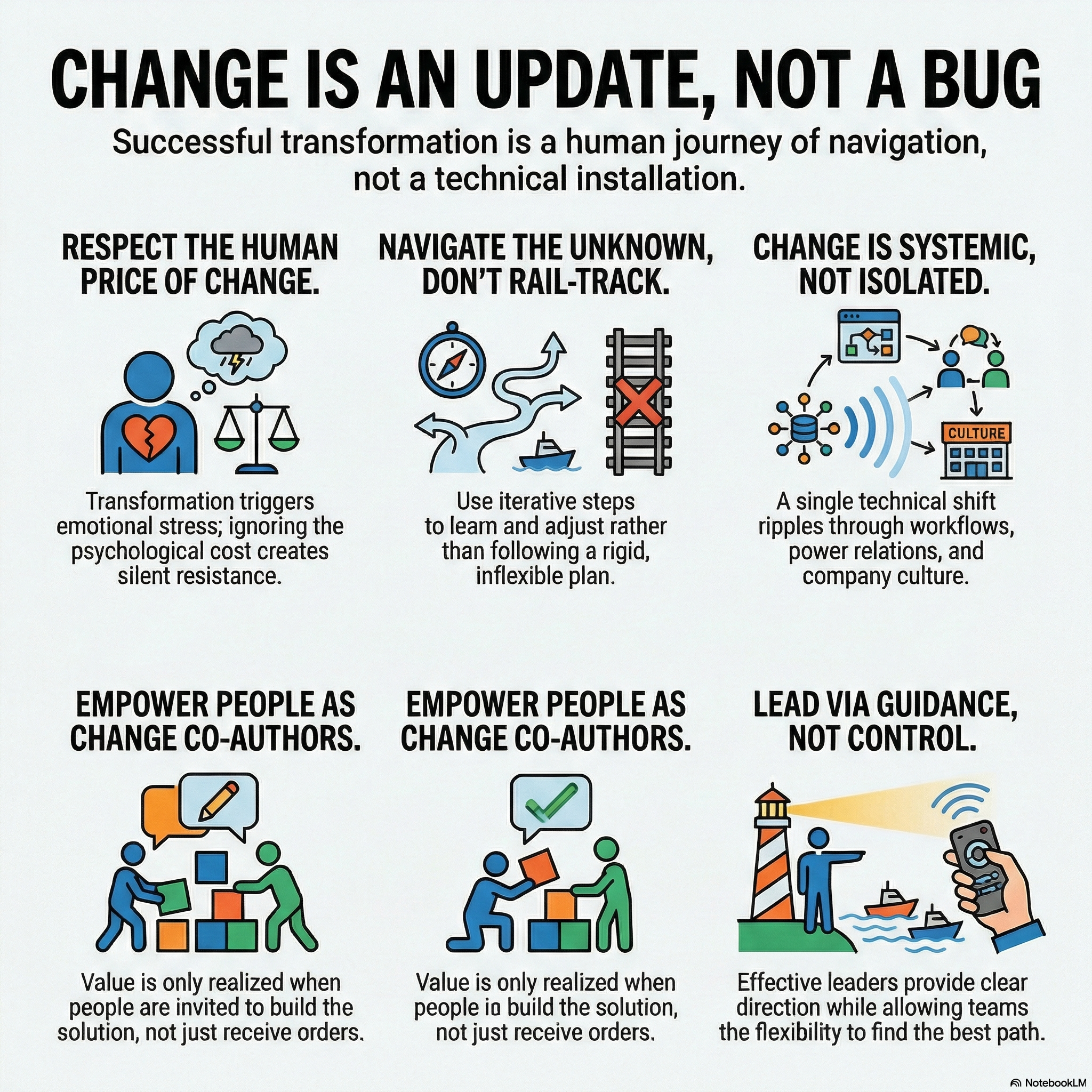
Every change demands emotional, cognitive, and social effort. People need to learn new things, abandon old habits, rebuild relationships, and redefine their place in the organization. That has a real cost: insecurity, mental overload, stress, and even fear of losing relevance. Ignoring this is the perfect recipe for silent resistance. Transformations that work are the ones that recognize this human price and offer support, clear communication, realistic timeframes, and space for adaptation. When the organization accepts that change is also a psychological process, not just a technical one, resistance decreases and engagement grows.
Read Also: The Definitive Guide to ITIL 5
Change is not predictable, it is navigable
Another dangerous myth is that change can be fully predicted and controlled. Organizations are complex systems. You never know all the variables before you start. When you try to force rigid plans based on fragile assumptions, the chance of failure skyrockets. ITIL 5 proposes something much more mature: change as navigation, not as following a railroad track.
You start from what you know, take small steps, learn from each move, adjust the course, and move forward. Instead of betting everything on one big, inflexible plan, you build change iteratively. This is exactly how agile teams work, how SRE operates critical systems, and how good leaders guide organizations. Uncertainty is not the enemy; it is the natural environment of transformation.
Successful transformations do not try to eliminate uncertainty. They create safe environments to learn within it.
Change never happens alone (even when it seems so)
Nothing changes in isolation inside an organization. A new system does not change only technology; it changes workflows, power relations, responsibilities, communication, and even how people see themselves. A change in the organizational chart does not affect only hierarchy; it changes informal networks, trust, collaboration, and autonomy. Even something as simple as adopting remote work transforms culture, leadership, communication, and control.
When you understand this, your way of planning changes. You stop asking “what do we need to change?” and start asking “who will be impacted, and how?”. This systemic view does not make change harder; it makes change possible.
In the end, change either respects people or it does not happen
ITIL 5 is very direct on this point: people are not the “means” of change. They are the decisive factor. Processes and technologies only deliver value when people believe in them, understand them, and incorporate them into real work.
Transformations that work put people at the center. They invite participation, explain the reasons behind decisions, offer practical support, open feedback channels, and allow real adjustments. They do not treat employees as passive receivers of orders, but as co-authors of change. This does not slow transformation down; it makes it sustainable. Otherwise, change may happen on paper, but it dies in everyday reality.
Leading change is not about control, it is about guidance
Another classic mistake is to think that leading transformation means total control. Organizations are far too complex for that. ITIL 5 proposes something much more effective: clear direction with flexible execution.
Successful transformation leaders do less engineering and more navigation. They observe, listen, adjust, define principles, and leave space for teams to find the best path within those boundaries. Instead of closed plans, they work with open directions. Instead of rigidity, they work with situational awareness.
It is the balance between firm purpose and adaptable method.
What does all this look like in a real transformation approach?
A mature transformation approach must be:
- Human and empathetic, because change without trust does not last.
- Adaptive and iterative, because rigid plans do not survive the real world.
- Holistic, because everything is connected: people, technology, processes, and culture.
- Context-aware, because every organization has its own dynamics.
- Humble and curious, because nobody knows everything before starting.
- Prepared and supportive, because change without support becomes organizational trauma.
- Engaging, because participation creates belonging.
- Business-aligned, because transformation without strategy becomes noise.
- Reflective and evolutionary, because only those who look back honestly can learn.
This is not a pretty list for a presentation. It is practically a survival manual for organizations in digital times.
At its core, ITIL 5 is saying something simple and powerful
Transformation is not about control. It is not about perfection. It is not about “implementing the right model.” It is about building the ability to change without breaking people, services, and culture in the process. It is about creating organizations that do not panic when context changes, because they have learned how to change continuously, humanely, and intelligently. And that, more than any framework or tool, is the true sign of digital maturity.