


There is an almost irresistible temptation in organizations: to believe that if a method worked once, it will work forever. It feels comfortable. It is like having a wrench and going out into the world thinking every problem is a bolt. Then ITIL 5 gently taps our hand and says: “Easy. Not every challenge is the same. Not every context needs the same tool.”
And this sounds obvious, but in practice it is the most common mistake in organizational transformation. Companies insist on applying the same project model, the same type of governance, the same planning rhythm, and the same control style to completely different situations. The result? Frustration, slowness, internal conflict, and that familiar feeling that “transformation is not moving,” even though everyone is working hard.
That is why ITIL v5 puts understanding context as the absolute starting point. Before deciding how to act, you must understand where you are standing.
Also read: The Definitive Guide to ITIL 5
Systems, not isolated problems
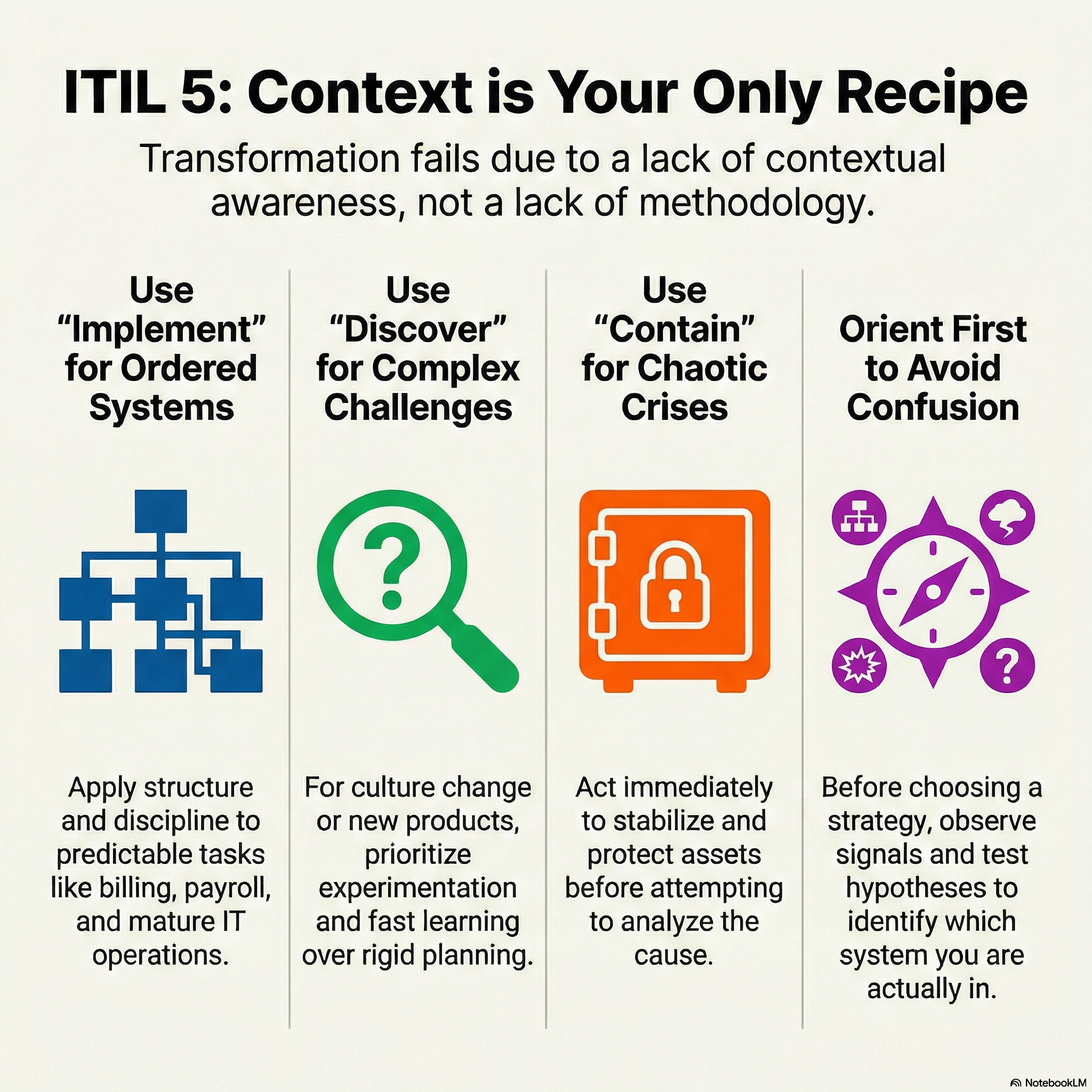
ITIL calls these different contexts “systems.” Not in the technical IT sense, but as organizational environments that behave in different ways. Some are predictable, others are completely unpredictable, and many are somewhere in between.
To explain this, it uses the well-known Cynefin framework, which divides contexts into five domains:
clear, complicated, complex, chaotic, and confused.
To simplify, ITIL groups clear and complicated as ordered, and associates each type of context with a different execution style.
It is as if ITIL were saying:
“Before choosing the gear, check whether you are on a paved road, a dirt trail, a forest, or in the middle of a fire.”
When everything is predictable: the ordered world
In ordered contexts, the relationship between cause and effect is known, or at least known by experts. This is the world of predictability.
Think about baking a cake. If you follow the recipe correctly, the cake comes out. Simple.
Many traditional business processes work like this: billing, payroll, accounting processes, mature IT operations. When you have done something dozens of times, you can plan, document, and execute with a high level of confidence.
In ITIL, this is the territory of the implement execution pattern.
- You know what to do.
- You know how to do it.
- Planning helps.
- Structure helps.
- Discipline helps.
Here, heavy methods are not a problem. They are the solution.
When nothing is fully predictable: the complex world
Now everything changes.
In complex contexts, you only understand the relationship between cause and effect after things happen. This is the world of “let’s see what happens.”
Creating a new product, changing organizational culture, transforming an operating model, entering a new market, deeply changing the way people work… all of this is complex.
The classic example is raising children: there is no definitive manual. What works for one child may not work for another. And it may not even work for the same child at different stages.
Here, trying to plan everything in advance is an illusion.
ITIL says the right pattern is discover: experiment, observe, learn, adjust, and repeat.
You are not seeking control.
You are seeking fast learning.
Real transformation lives much more in this territory than in the ordered one.
When the world is on fire: chaos
In chaos, there is no time for elegant thinking.
No committees.
No SWOT analysis.
No design thinking workshops.
Think of a fire.
The priority is to get people out.
Only later do you investigate the cause.
This is the contain pattern: act fast to stabilize, contain the damage, protect what is essential. Only after that comes understanding and improvement.
Many security crises, massive system failures, or operational collapses fall into this category.
Detailed planning at this moment is not a virtue. It is a risk.
And when you do not know where you are? Welcome to “confused”
The most common initial state is confusion.
You do not yet know whether the problem is ordered, complex, or chaotic.
This is where the orient and decide stages come in: observe, look for signals, listen to people, test hypotheses, and only then choose the appropriate execution pattern.
Many organizations skip this step and jump straight into execution with the wrong approach. Then they blame the methodology.
The most common mistake: pretending everything is ordered
Organizations love ordered contexts.
They give a sense of control, predictability, and managerial comfort.
So many companies pretend that complex situations are just “complicated.”
They treat cultural change as if it were software installation.
They treat digital transformation as if it were a server replacement.
The result?
They try to apply expert solutions where experimentation was needed.
They try to use rigid schedules where continuous learning was required.
They try to impose control where adaptation was essential.
And transformation stalls.
ITIL 5’s core lesson is brutally simple
There is no “best method.”
There is only the right method for the right context.
Detailed planning is wonderful… in the wrong context, it is poison.
Experimentation is powerful… in the wrong context, it is waste.
Immediate action is essential… in the wrong context, it is panic.
Understanding context is not a detail.
It is the most strategic decision in any transformation.
At its core, ITIL is asking for organizational maturity
It does not want companies that “follow frameworks.”
It wants companies that can read their environment, recognize patterns, and change behavior according to the situation.
It is leaving autopilot mode and entering conscious mode.
Because transformation does not fail due to lack of method.
It fails due to lack of contextual awareness.
And when an organization learns to do this well, it stops asking:
“Which methodology should we use now?”
And starts asking something much more powerful:
“What kind of system are we in, and how should we act here?”