

Technology never stops evolving, and with the release of the new ITIL 5, the technology market is witnessing a fundamental paradigm shift. If we used to speak almost exclusively about ITSM (IT Service Management), ITIL 5 now invites us to master DPSM (Digital Product and Service Management).
But what does this mean in practice for your career and for your organization’s governance? In this article, we will unpack this transition and understand why the union between products and services has become the new gold standard in the market.
Also read: The Definitive Guide to ITIL 5
What Is DPSM and Why Does It Replace the ITSM-Centered Focus?
Historically, IT Service Management (ITSM) focused on delivering value through processes and support. However, in today’s world, the line between a “product” and a “service” has become almost invisible.
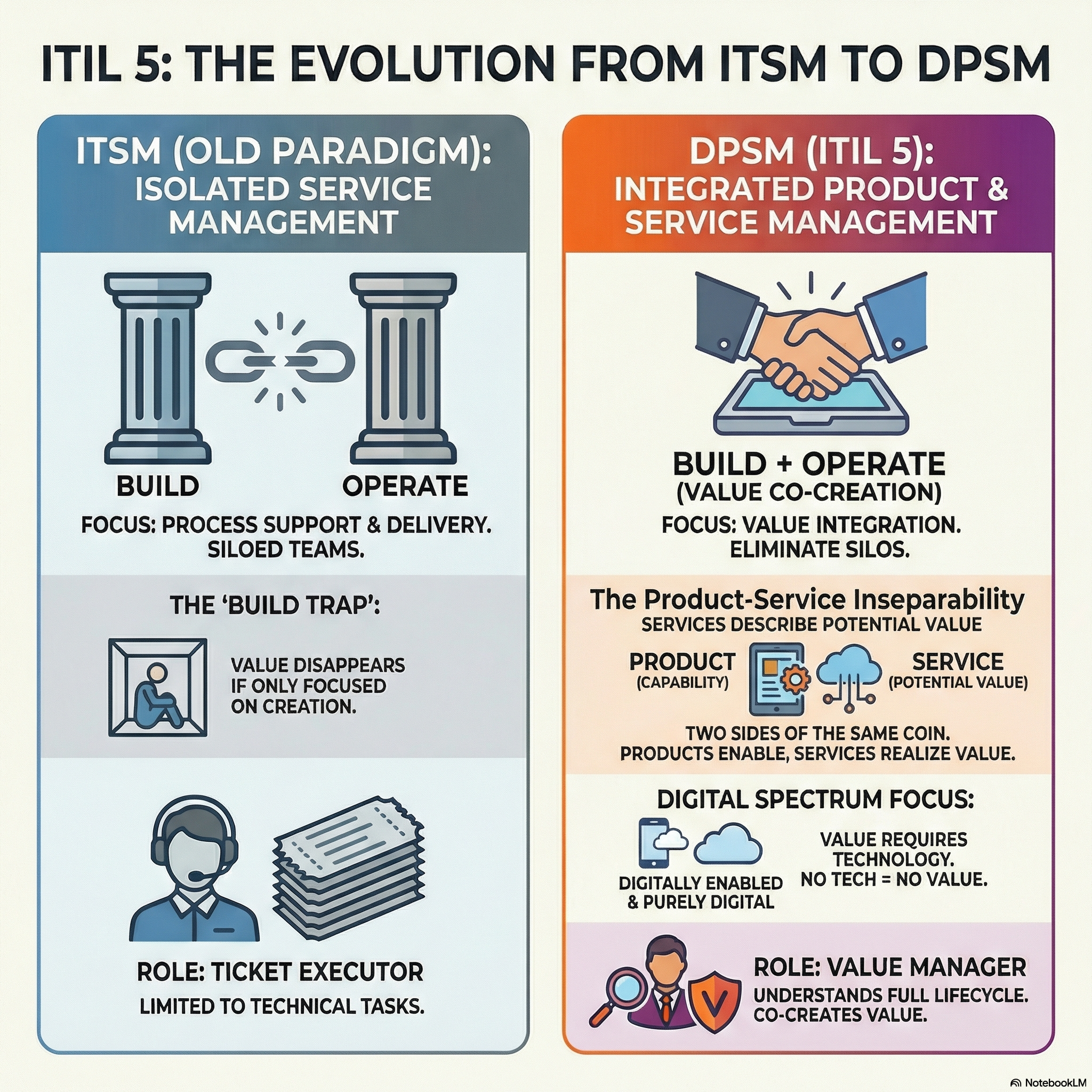
Is a banking app a product or a service? According to ITIL v5, the answer is: both. DPSM emerges to eliminate the silos between the teams that build the product and the teams that manage the service.
ITIL Version 5 proposes integrating these disciplines. This helps avoid what the framework calls the “build trap,” where organizations keep delivering new features without understanding whether they truly generate value for the end customer.
Understanding the Anatomy: Digital Product vs. Digital Service
To master the transition from ITSM to DPSM in ITIL 5, it is essential to understand the new fundamental definitions introduced by the framework:
- Digital Product: A combination of an organization’s resources based on digital technology, designed to deliver value to consumers.
- Digital Service: A service that depends entirely or largely on digital products.
ITIL 5 explains that services are always based on products. The product provides the technical capability, while the service offering describes the potential value. Once the customer accepts the offering, delivery and consumption begin.
In simple scenarios, a service may rely on a single product. However, in complex ecosystems, one product can support multiple services simultaneously.
The Digital Spectrum: Where Does Your Organization Fit?
Not every product is 100% digital, and ITIL 5 provides an essential classification to help us understand modern management complexity. The framework presents a spectrum ranging from analog to digital:
- Purely Analog: Products that function without any digital technology.
- Digitally Supported: Core functions work without technology, but digital is used for secondary functions.
- Digitally Enabled: Have physical components but depend on technology for core functionality. Without digital, their value disappears (e.g., modern cars or smartphones).
- Purely Digital: Software products with no physical components.
ITIL 5 guidance focuses primarily on the last two levels. Managing a “digitally enabled” product requires a holistic view that traditional ITSM alone could not fully address.
Practical Benefits of Shifting to DPSM
Adopting a DPSM mindset brings immediate gains for corporate governance and for professionals in the field. Here’s how it impacts day-to-day operations:
For Organizations
- Enables a more sustainable and adaptable digital strategy.
- Shifts the focus toward value co-creation, integrating AI and automation ethically and efficiently.
- Improves collaboration between internal teams and external suppliers.
For Professionals
- Provides a clear understanding of each individual’s role in value creation.
- IT professionals move from being “ticket executors” to becoming digital value managers by understanding business and customer context.
The End of Silos
ITIL 5 encourages a collaborative culture that promotes safety, respect, and creativity, connecting development (Build) and operations (Operate) into a continuous cycle.
How DPSM Boosts Your Career
If you are pursuing certification or aiming for leadership roles, understanding the shift from ITSM to DPSM in ITIL Version 5 is essential. The market no longer seeks only process specialists; it seeks professionals who understand the full lifecycle of products and services.
Mastering DPSM means gaining a big-picture view of management, knowing how to integrate other frameworks such as Scrum, Lean, and DevOps within ITIL’s value structure. This increases your operational versatility and positions you as a strategic enabler of business outcomes.
ITIL Version 5 is not just a theoretical update; it is a practical guide for surviving and thriving in an economy where digital is the backbone of everything we do.
Want to get ahead and become one of the first professionals certified in the new version of ITIL?
At PMG Academy, we prepare you to master DPSM and transform your organization’s IT governance using global best practices. Explore our courses and certification tracks and start your journey toward ITIL 5 mastery today!
Have you experienced this “product vs. service” conflict in your organization? Share your experience in the comments!