

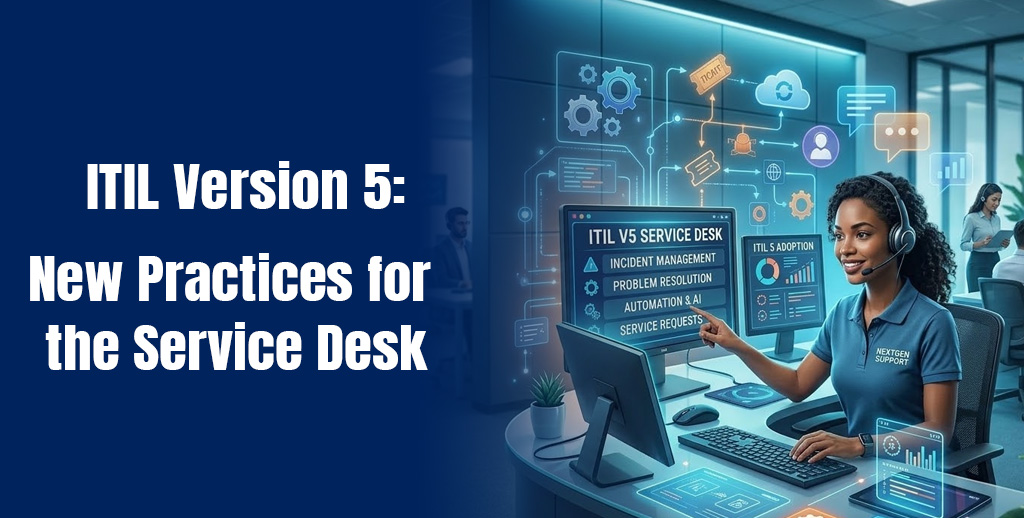
IT service management is entering a new era. With the arrival of Industry 5.0, organizations have shifted their focus toward human centricity, sustainability, and resilience. In this context, ITIL 5 (ITIL Version 5) emerges as the definitive guide for transforming technical support into a strategic unit for value co-creation.
For Service Desk professionals, understanding these changes is not just a matter of technical updating, but an essential competitive differentiator. This article explores how the new ITIL v5 practices can be applied to make support more agile, intelligent, and focused on what truly matters to the business.
Also read: The Definitive Guide to ITIL 5
Browse topics of interest:
ToggleWhat Is ITIL Version 5 and Why It Matters for the Service Desk
ITIL 5 is the evolution of the world’s most widely recognized best-practice framework for managing digital products and services. It is critical for the Service Desk because it reflects the reality of modern organizations, which operate under high complexity and must integrate emerging technologies such as Artificial Intelligence (AI).
What ITIL Means in the Context of a Service Desk
In the Service Desk context, the New ITIL defines the practice as the Single Point of Contact (SPOC) between the service provider and users. Its primary function is to capture demand for incident resolution and service requests. More than a help counter, it acts as the frontline that ensures data intake and shapes the user’s perception of value.
The Evolution of ITIL: From ITIL v3 to ITIL 4 and the ITIL 5 Vision
The ITIL journey reflects continuous adaptation to market needs:
- ITIL v3: Focused on the “IT Infrastructure Library” and rigid lifecycle processes.
- ITIL 4: Introduced value co-creation and the Service Value System (SVS), focusing on value streams.
- ITIL 5: Expands this vision to be complexity-native and AI-native. It emphasizes the transition from “humans operating technology” to “humans collaborating with technology,” prioritizing user experience and organizational agility.
The Foundation of the ITIL Approach to Service Management
The foundation of ITIL is value co-creation. A service is defined as a means of enabling desired outcomes for customers without requiring them to manage specific costs and risks. For the Service Desk, this means success is not measured only by ticket closure, but by the positive impact the solution has on the user’s work.
ITIL 5 Principles Applied to the Modern Service Desk
The ITIL Guiding Principles provide recommendations that guide organizations in all circumstances. In the Service Desk, they serve as a compass for fast and effective decision-making.
Focus on User Experience and Perceived Value
The Focus on Value principle requires that every Service Desk interaction be evaluated through the lens of User Experience (UX) and Customer Experience (CX). Value is subjective and changes over time, so the Service Desk must continuously collect feedback to ensure technical support aligns with users’ emotional and functional expectations.
A Holistic Approach to Service Management
The Think and Work Holistically principle teaches that no incident or request exists in isolation. The Service Desk must understand how its work affects the four dimensions of service management and how it integrates with organizational value streams, avoiding information silos.
Continuous Improvement as a Core Service Desk Practice
Continuous Improvement must be part of the Service Desk’s DNA. Using the ITIL Continuous Improvement Model, teams should constantly ask: “Where are we now?” and “Where do we want to be?” This involves analyzing performance metrics, incident trends, and feedback to optimize support processes.
The Four Dimensions of Service According to ITIL
To ensure a complete view of service management, ITIL defines the Four Dimensions. The Service Desk must balance all four to be effective:
1. Organization and People
This dimension covers culture, leadership, roles, and competencies. In the Service Desk, it means having professionals with emotional intelligence, strong communication skills, and a culture of psychological safety that encourages learning from failures.
2. Information and Technology
This includes the knowledge and tools required, such as ticketing systems, knowledge bases, and—especially in ITIL 5—the use of AI for data processing and automation.
3. Partners and Suppliers
This dimension addresses relationships with external organizations involved in support. The Service Desk often depends on third-party providers (such as cloud vendors) and must manage these dependencies in an integrated way.
4. Value Streams and Processes
This dimension defines activities and workflows. Value Stream Mapping helps the Service Desk visualize the path from ticket creation to solution delivery, eliminating waste.
New ITIL 5 Practices for the Service Desk
ITIL 5 introduces a pragmatic approach to handling modern technology in support operations.
Centralizing the Service Desk as a Single Point of Contact (SPOC)
The Service Desk practice has evolved to omnichannel communication. The goal is to provide a consistent entry point—via chat, phone, email, or self-service portals—ensuring a seamless user journey.
Intelligent, Value-Based Ticket Management
Rather than simply following first-come, first-served order, ITIL 5 encourages value-based prioritization. This means identifying which tickets have the greatest impact on business outcomes and user experience, and allocating resources strategically.
Automation and the Use of ITSM Tools
Automation is essential for scaling support. ITIL 5 introduces the AI Capability Model (6Cs):
- Creation: Automatic generation of responses and documentation.
- Curation: Data cleansing and removal of duplicate records.
- Clarification: Summarizing complex tickets to simplify analysis.
- Cognition: Identifying patterns and bottlenecks.
- Communication: Chatbots that interact naturally with users.
- Coordination: Automatic escalation and intelligent triage.
Integration with DevOps, Agile, and Digital Practices
The modern Service Desk does not operate in isolation. It integrates with Agile and DevOps practices, providing fast feedback to development teams about product performance in live (production) environments.
Service Desk Systems and Tools Aligned with ITIL 5
Choosing the right technology is a pillar of the Information and Technology dimension.
Most Commonly Used Service Desk Systems
The most effective tools are ITSM platforms that natively integrate incident, change, and problem management with service catalogs.
Widely Used Tools for Ticket Management
Workflow and task management tools are widely used to organize work, enabling progress visualization through Kanban boards and real-time dashboards.
How to Choose an ITIL-Compatible Service Desk Tool
When selecting a tool, consider:
- Automation Capability: Support for AI and automation of repetitive tasks.
- Observability: Ability to analyze logs, metrics, and traces to understand system health.
- Integration: Ease of connecting with partner and supplier tools.
Best Practices for Ticket Categorization and Prioritization in ITIL 5
Correct categorization is the first step toward efficient resolution.
Best Practice for Categorizing Tickets in a Service Desk
The best practice is to align categorization with the Service Catalog. This makes it easier to identify which services generate the most demand and where improvement efforts should be focused.
Impact vs. Urgency: Defining Priorities Correctly
Priority should be determined by combining:
- Impact: The extent to which an incident affects business processes.
- Urgency: How long the business can wait for resolution.
This matrix ensures the Service Desk focuses on what is most critical to the organization.
How Categorization Influences SLAs and Operational Efficiency
Accurate categorization allows Service Level Agreements (SLAs) to be properly monitored, ensuring response and resolution times meet expectations for each service type.
ITIL Certification and Training for Service Desk Teams
Investing in corporate education is the path to mastering ITIL 5.
What Is ITIL Certification and Who Is It For?
The ITIL Foundation certification is the mandatory starting point. It is recommended for all IT professionals—from Service Desk technicians to C-level executives—who want to speak the global language of service management.
Benefits of ITIL Certification for Service Desk Professionals
- Mastery of concepts such as value co-creation and value streams.
- Better understanding of roles and responsibilities.
- Increased employability and professional recognition.
ITIL 5 as a Competitive Differentiator in the IT Market
Being up to date with Version 5 demonstrates readiness to handle Digital Transformation and the ethical, strategic use of Artificial Intelligence.
How to Implement ITIL Version 5 in Your Company’s Service Desk
Implementation should be treated as a transformation journey.
Assessing the Current Maturity Level
Use the ITIL Maturity Model to conduct capability assessments. This helps identify which practices are at an initial (ad hoc) level and which are already optimized.
Step-by-Step Adoption of ITIL 5 Practices
- Define the Vision: Align Service Desk goals with company strategy.
- Assess the Current State: Understand existing processes and technologies.
- Set Goals: Establish SMART improvement objectives.
- Act: Implement changes iteratively, starting with quick wins.
Common Mistakes When Implementing ITIL in the Service Desk
- Trying to implement all processes at once (ignoring iteration).
- Focusing only on tools and neglecting the Organization and People dimension.
- Failing to measure real value as perceived by users.
Conclusion: The Future of the Service Desk with ITIL Version 5
The future of the Service Desk is to become a center of intelligence and value. With ITIL 5, support moves from reactive to strategic, using technology to enhance human capability.
Key Operational and Strategic Gains
Organizations that adopt ITIL 5 gain agility, cost reduction through intelligent automation, and—above all—resilience to face constant change in the digital market.
ITIL 5 as the Foundation for a More Efficient, Value-Driven Service Desk
By adopting this approach, your organization builds a solid foundation for continuous innovation, ensuring IT becomes a growth engine rather than just technical support.
Frequently Asked Questions About ITIL Version 5 and Service Desk (FAQ)
What does ITIL mean in the context of a Service Desk?
It is the Single Point of Contact (SPOC) for managing incidents and requests, ensuring value delivery to users.
What are Service Desk systems?
They are ITSM tools that integrate ticket management, knowledge bases, automation, and monitoring.
What is the foundation of the ITIL approach?
Value co-creation by enabling customer outcomes while managing costs and risks.
What are the four components of an ITIL service?
Organization and People, Information and Technology, Partners and Suppliers, and Value Streams and Processes.
Want to transform your company’s Service Desk and earn your certification?
Explore PMG Academy courses, a reference in corporate education for IT Governance and Agility. Access our Complete ITIL 5 Guide and take the next step in your career.
Did you like this content? Share your experience with ITIL in the Service Desk or ask your questions about the new version in the comments!
Categorias
Artigos Relacionados
IT Asset Management nowadays
Traditionally, IT Asset Management has never received the focus it deserves. This changed with the
Risk management: how NOT to do it
If you work with information technology, you know how important risk management is. After all,